
Skill 02 of 08
Knives
Cut faster, safer and more evenly, with three knives you will use for life.
Even cuts cook evenly. That is the whole reason knife skills matter: not speed, not showing off, but a pan of onions that are all done at the same time. A sharp knife and a good grip will do more for your cooking than any gadget.
This lesson is free, start to finish. So is every other one.
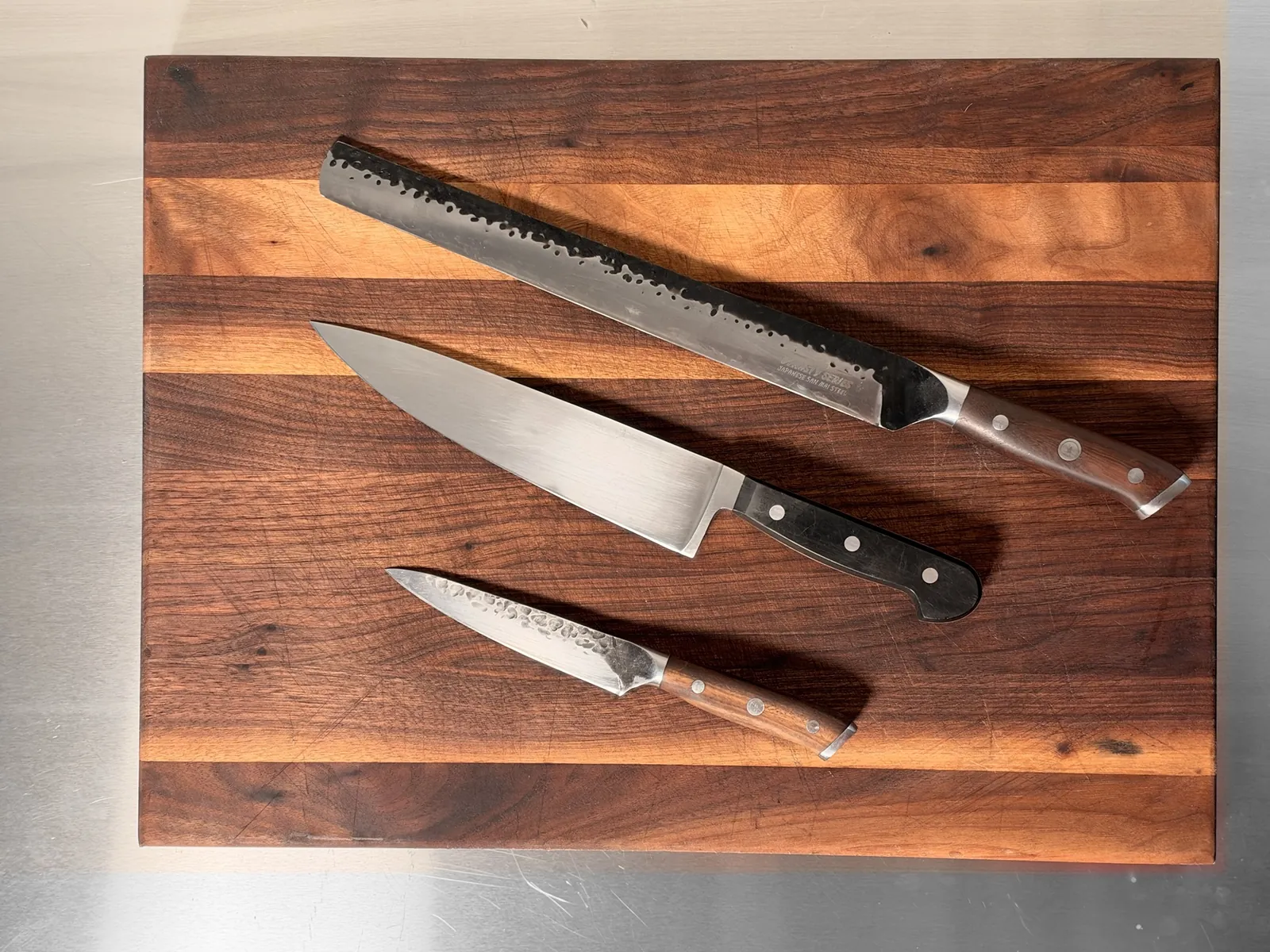
The three knives you need
- A chef’s knife, 8 inches. Ninety percent of your cutting. Buy one good one and keep it sharp.
- A carving knife: long, thin, with a straight edge. Kept razor sharp it slices a roast, a loaf of bread and a ripe tomato clean. A serrated knife tears, and you can’t hone it at home.
- A petty knife, 5 to 6 inches. The prep knife. Small enough to trim and peel, big enough for a shallot or a chicken thigh.
- That is it. A block of twelve knives is nine you will not use.
- When you want more: a paring knife and a santoku. After that, a cleaver, a small chef’s knife, a small santoku and a nakiri for vegetables.
How to hold it
Pinch the blade just in front of the handle between your thumb and the side of your bent index finger, and wrap the other three fingers around the handle. This is the pinch grip. It feels odd for a day and then it feels like the only way. You get control from the blade, not the handle.
Your other hand is the claw. Curl your fingertips under so your knuckles face the blade, and let the flat of the blade ride against your knuckles. The knife cannot cut what it cannot reach. Move the claw back, the knife follows, and your fingertips are never in the way.
The cuts
- Slice: straight down and slightly forward. Let the edge do the work; do not press.
- Dice: slice into planks, stack the planks and slice into sticks, turn and cut across. Small dice is about a quarter inch, medium a half inch, large three-quarters.
- Mince: dice first, then rock the blade over the pile with your other hand flat on the spine until it is as fine as you want. Garlic, ginger, herbs.
- Julienne: the sticks from a dice, left as matchsticks. Carrots for a stir-fry, peppers for fajitas.
- Chiffonade: stack leaves, roll them tight, slice across. Ribbons of basil or spinach.
- Rough chop: when it is going in a stock or a blender and nobody will see it. Fast and uneven is fine.
Safety
- A sharp knife is safer than a dull one. A dull knife slips; a sharp one goes where you point it.
- Cut on a board that does not move. Towel underneath.
- Make a flat side first. Halve the onion, halve the carrot, so it sits still.
- Never catch a falling knife. Step back.
- Carry it point down at your side. Never leave it in a sink full of water.
Care
Hand wash, dry straight away, and store it on a magnet strip or in a block, never loose in a drawer. Run it over a honing steel before you cook; that straightens the edge and keeps it cutting. Sharpen it, which actually removes metal, a few times a year on a whetstone or at a shop that does it. Cut on wood or plastic. Glass and stone boards wreck an edge in a week.
When it goes wrong
- Uneven pieces
- Slow down and make a flat side first. Even comes before fast.
- The knife slides off an onion or a tomato skin
- It’s dull. Hone it. If that doesn’t fix it, it needs sharpening.
- Sore hand or wrist
- You’re gripping the handle and pushing down. Pinch the blade and let the edge slide forward.
- The board walks across the counter
- Put a damp towel under it.
- Herbs turn dark and wet
- A dull edge is crushing them. Sharpen the knife and slice once. Don’t chop back and forth.
Practice on these